26 October 2014

With Bonnie and Wendy in Rome, Thursday, 23 October 2014

Thursday, 23 October 2014 – Everyday life


We are about to move into daily life, both modern and ancient.  We walk to the Colosseo metro station and take linea A to EUR Magliana and transfer to the Ostia line to Ostia Antica.  The metro is full of life – everyday life.  It’s interesting to watch people go about whatever their business is, and it leads me to wonder what their life is like (where they live, what they do, what their mood is, etc.)  Bonnie was hoping for a nice train trip, comfortable seat, a window, scenery passing by, but none of that was to be had.  Like the Romans on board, we too stood and waited for the station we wanted.


Just as in Rome along the Via Appia, the entry into Ostia Antica from the east is a highway through tombs.  To enter the city teeming with life one must first honor the dead.  Like the cemeteries that we know, these tombs are a mixture of simple and ornate, stone and brick.  The ornate brickwork shown above is outstanding. In fact there was a college of brick workers in Ostia, their headquarters still standing.  In that building we can see the pride they took in their work.  Once through the gate and into the city one sees rows of storage and workhouses, and then there is pleasure and health.


At the Thermii Cisarii we see a large array of rooms, the floors of which are all mosaic.  It was here at the baths of the cart drivers that we get to see some wonderful work both ancient and modern.  The mosaics are black and white, but wonderfully ornate – depicting gods and goddesses and all the mythos of the Romans. Working on the floor, however, are curators and restorers as they work on each of the floors.  Some are covered for a time, to save them from the elements, and others are left for us to see, and even more are in the process of restoration.


One thing that has been added to Ostia Antica is the placement at various places in the town of contemporary sculpture, most of it with a classical feel.  Some of the placements work quite well, so that you don’t get the feeling that you have stepped out of time.


Again, like the Neronian Cryptoporticus on the Palatine Hill there are examples of stuccowork that have survived.  The work shown here is at the theater, in the central aisle that serves as an entrance to the seats.  What is interesting about this work is that if you look closely you can see the work of the artisans in sketching out the placement of stuccowork that was placed later.  Again, a reminder of human daily life and work.  To the rear of the theater is a “mall” of sorts, lined with the stalls for the various corporations that plied their trade at Ostia’s harbor.  In the front of each stall is a black and white mosaic depicting fish, ships, rivers, or gods, meant to indicate the kind of work the corporation was involved in.


After a “lunch” at the bookstore/restaurant on the site, we go to the forum of Ostia and see the remains of a large Pantheon-like circular structure that sits opposite the Curia in Ostia.  To the west and a bit behind is a shrine where the town Lares sat, and lovely example of brickwork.  There are other sacred places in Ostia, temples, and shrines, and a couple of Nymphaeum.  The one pictured below was later converted to Christian use as, I suspect, a baptistery.  In fact a martyr is honored with a plaque here.  There is a Synagogue in the forum area and at least one Mithraeum as well.


The sun begins to sink slowly in the west and we take a train back to Rome, getting off at Circo Maximo.  We decide to walk over to Trastevere to have dinner, so we walk along the circus, making a brief stop by the Temple of Vesta on the banks of the Tiber.


It is a lovely building and I’m sorry that we can’t stop in to see Sancta Maria in Cosmedian that sits right across the street.  We take the bridge that connects Isola Tiberina with both the east and west banks.  At the end there is a church dedicated to Saint Bartholomew, which also serves as his burial place.  My friend Barton and I bumped into this place in 1989, and I wanted to show it to Bonnie and Wendy.  In the center of the stairs leading up into the chancel, there is a wellhead.  It seems that in ancient times this was an asklepieion where healing and dream telling was done. The well is a remainder of that site, and is still use in healing offices. 


We make our way into Trastevere, and I get us lost.  However, we are near a restaurant where people are standing in line to get in.  Wendy sees the possibilities of something wonderful here and so we stand in line to get into da Enzo al 29. We do get in and it is flat out wonderful.  We all start out with the Panzanella, a composed and moulded salad of bread, celery, tomato, basil, olive oil, and lemon – quite good. I have the Cacio e Pepe, a simple dish of wide spaghetti dressed simply with a very fine pecorino and lots of pepper. It was quite delicious. I followed that with Polpette, but quickly came to the opinion that the Polpette at Piccino in San Francisco are much better. I don’t remember dessert, which says something.  We all agreed, however, that it was a superb experience and would go back in a minute.


We walked back to Navona through Campo di Fiori. I really over-reached the walking part. I need to ask Bonnie and Wendy if we need to take a cab!

25 October 2014

Rome with Bonnie and Wendy, Wednesday, 22 October 2014

Wednesday, 22 October 2014 – Touching the Past


I’ve noticed something that is really quite touching (and here no pun is intended).  My sister Wendy has the habit of encountering the really ancient by touching the object – to take it in deeply.  There is awe in all of us really about the past, and today we attempted to take it in – deeply and profoundly.  The first stop at the Roman Forum was at the Curia, which was unfortunately closed, due to work on the Arch of Septimus Servus, next door.  It was open the last time I was here, and it is always moving to me to be in an ancient room, where people known and unknown to me have lived out life.  That was not to happen today, at least not here.


I think it is that coming from a disposable society and peering into a society that values and uses the ancient we begin to see what we are missing in not being able to connect with what has come before us.  Here it is tangible.  So it is a delight to take Bonnie and Wendy over to the House of the Vestal Virgins and to see not only their imperial digs, but the republican digs that have been discovered a couple of meters below. 


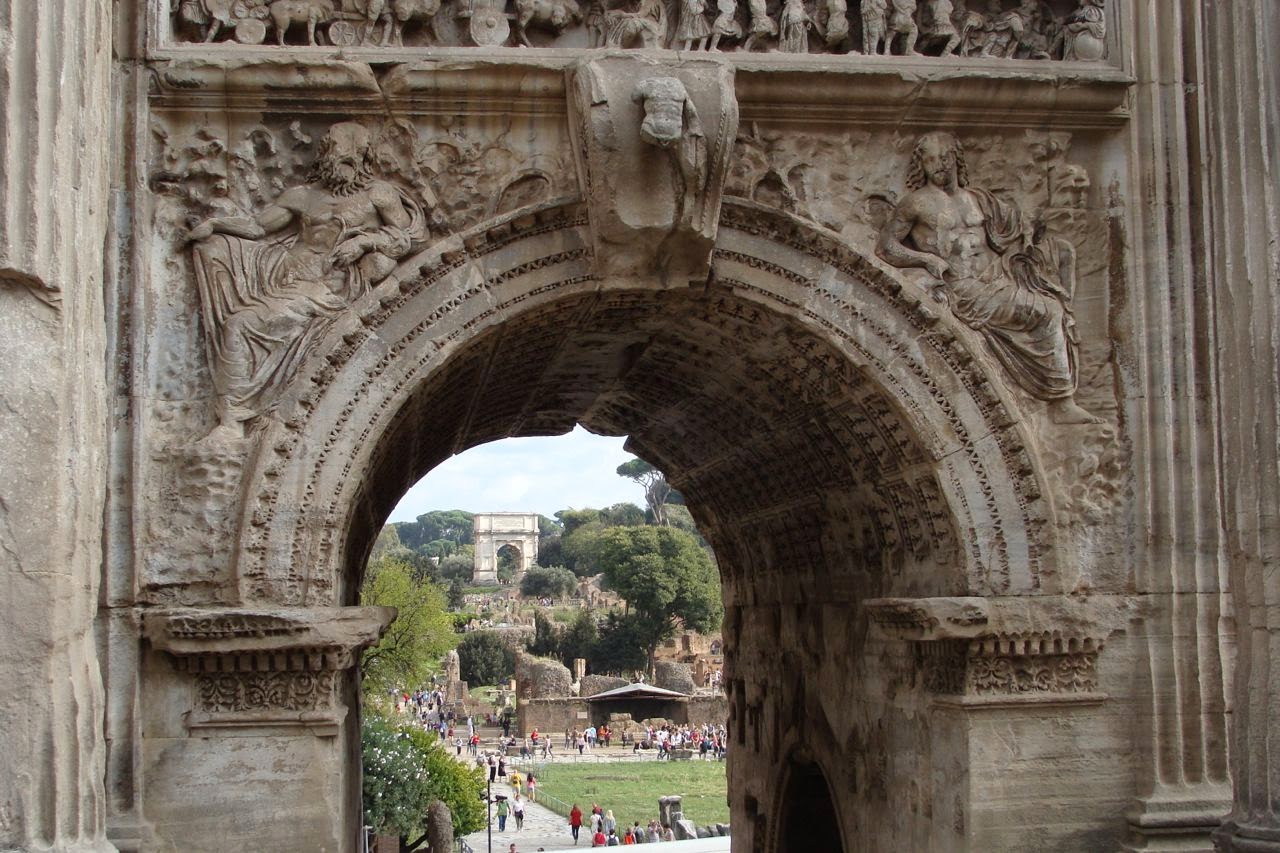
Before we begin our way up the Palatine Hill, we stop by the Arch of Titus.  The history that stands around and within the meanings of this monument moves me.  Earlier in my life I was able to visit Masada, and see the siege ramp that Titus’ general Silvus built to reach the height of the mesa (as they say in New Mexico).  That it still stands there and that one can see the remains of Roman encampments, their neat squares doting the desert, makes it all the more rich and understandable.  All of that is brought together in this monument that celebrates the victory over Judea, and the plunder of the Temple in Jerusalem. Isn’t it odd that the history of others eventually becomes our own as well.  Standing at this monument, I become fully aware of that.


We work our way up to the Palatine where we experience some really remarkable views.  From the palace of Domitian one can see the Coliseum off to the southeast and from the western edge St. Peter’s profile becomes evident.  It is a windy day, and palatine dust is soon on clothing and in eyes.  Delights that I had hoped to show Bonnie and Wendy, such as the House of the Griffons, is closed and unavailable. (The Domus Aurea of Nero is also closed for repairs after a cave-in – also a disappointment).  So we celebrate what we can see.  The views from the Farnese Gardens are always a delight, and a visit to the Nymphaeum under the pavilions of the gardens is a pleasure as well.  I take Bonnie and Wendy through the Neronian Cryptoporticus, where they can see some original stucco decorations on the ceiling.


After that we leave the hill, briefly look at the Basilica of Maxentius (which is being fortified due to the Metro Linea C that is being built directly below it), and go out for liquid and lunch.

Wendy leaves us to see a church with catacombs and displays of bones.  She's a medical illustrator, and this is right up her ally.  Bonne and I meander next to the fora that line the eastern side of the Via dei Fori Imperiali and especially enjoy Trajan’s Column.  We wander back through the area around the Pantheon to look at vestments, prints, and people.  Always crowded, the Pantheon always amazes.


Dinner is at Facoincasa near Navona – wonderful fagioli romana, and lamb chops that were exceptional.  Time for sleep.

21 October 2014

Rome with Bonnie and Wendy, 19-21 October 2014

Sunday, Monday, Tuesday – 19-21 October 2014

Sunday

Leaving on this trip is complicated by a text message that a Lufthansa pilot strike has cancelled my flight from München to Roma.  Grief and disbelief followed.  I rushed from the choir concert at Saint Mark’s (which I regretted having to leave) in order to drop by the airport and make other arrangements.  Lufthansa is not there, so I go home, grab my bag, and Arthur takes me back.  Long and short: I am rerouted on United to London and then on Alitalia from Heathrow to Rome.  At Heathrow I have to get a boarding pass from Alitalia, which proves to be a minor problem (such disorganization) and has to be produced manually – but I am given a Business Class Seat.


Monday
I arrive at 8:05, Passport control is easy, no visa stamp, however.  My baggage, which is marked “Priority”, is the last piece out!  My driver is there, and getting to the apartment is a bit of an ordeal.  It sits a good three flights of stairs up from the street, but is lovely.  Bonnie and Wendy are already here, so we walk over to Navona for a bit, and have dinner at a place Louis and I enjoyed a couple of years ago.  Now we are all tired, so it’s back to the apartment, and I crash.


Tuesday
Breakfast at Navona, and the plaza is crowded – there’s no off-season here.  Bonnie and Wendy have Spaghetti Carbonara pizzas (who knew) and I have bruschetta pomodoro along with carciofi giudia.  Delicious!  We walk to the Pantheon coming at it from the far side of the piazza.  It is always overwhelming, and Wendy is beside herself with excitement.  She and Bonnie take photos while I stand in place and just absorb – it think it is the most wonderful sight and place in Rome.  We walk the perimeter to see the brick construction and how the building was once a part of a much larger complex of buildings, some of which is preserved at the rear.  Wendy is gracious as I mention my mounting misanthropy – “At least there here, looking at it, taking it in.” – a good comment.


We go by Barbiconi, a wonderful vestment shop, but I don’t go in.  Perhaps later I’ll see if there is anything that “I need”.  My intent is to take them to Campo di Fiori, but we get lost in the Jewish Quarter, and make our way over to the Capital, and then an overlook of the Forum right by the Arch of Septimus Servus.


Wendy is amazed at the extent of the ruins, and wants to go down right away.  I convince here that we will need a whole day, so we will go on Wednesday.  We walk along the edge, giving them both a taste of what is to come.  There is a huge excavation at the base of the Basilica of Maxentius where they are building Linea C of the Rome Metro.  The Colosseum looms beyond and both are anxious to visit there.  We are there in the evening and the light is just magic.  We talk about architectural details and the various stages of development of the arena.


We take time for a quick antipasto and drink across the street, first looking at the remains of the gladiatorial school.  Then it’s back up to the Trajan Forum, whose column is bathed in blue light and up the Trevi Fountain (which is being restored and not magic at all).  The Spanish Steps are disappointing as well with Trinita dei Monti all covered up for its restoration.  We go to Otello della Concordia for dinner (zucchini fritti with anchovies – really good, and Wendy and I have osso bucco with rice, and Bonnie a spaghetti dish).  Lots of memories here.

We walk down the street and end up by the Tomb of Augustus with its marvelous Mussolini buildings on the northern and eastern edges of the site.  I show them the Richard Meyer building with the Ara Pacis, and hope we can come back.  We walk back to Navona for tartufi at Tre Scaline.  Wonderful