19 October 2010

A sermon for Saint Luke's Day


“A Stewardship of Healing”
St. Luke, Evangelist
17 October 2010

Trinity Episcopal Church
San Francisco, California


Ecclesiasticus 38:1-4, 6-10, 12-14
Psalm 147
II Timothy 4:5-13
St. Luke 4:14-21

INI

I.               Stewardship – what is it?

In the biblical story of Joseph, the character of Joseph is slowly revealed to the hearer or the reader.  Gifted, arrogant at times, honored and loved by his father, regarded suspiciously by his siblings, this young man would become a salvation for his family, if not the nascent people of Israel.  In his story he moves from the plains and hills of Palestine, and the relative wealth of his father’s household to the narrow river culture of Egypt and to the household of the Chief Steward of Egypt where he serves as a slave, and incidentally as a seer.  The dream-telling qualities of Joseph’s life is only one aspect of his story and service, and it serves him well as he moves into his new community, and eventually through his visions becoming a steward for the people of Egypt. 

Joseph, like most stewards, knew that the goods, the visions, and the wealth that he managed for the benefit of others was not his own.  He was thrust into that knowledge by his forced sale into slavery.  The slave had no rights, no property, really – but often earned the respect of their wealthy owners through a just and virtuous exercise of their stewardship.  The Bible is full of stories about these men and women, and Jesus uses them as an example of ingenuity and intellect.  All of them operated with the knowledge that they had to make an accounting, and that sometimes they needed to give up what might have been theirs in order to meet the expectations of the owner.

Stewardship is often regarded by many, especially at this time of the year as an uncomfortable and embarrassing request for our wealth.  This perspective comes to us absent the basic idea of stewardship, namely, that we operate with gifts, talents, skills, and wealth that has been entrusted to us.  In our culture of money and achievement, these things are seen as property, rather than as the gifts that they are.  Thus, it is a good thing to look at lives that were informed differently, and at the stewardship of those who understood stewardship and its responsibilities.

Today we honor St. Luke, and indirectly, we honor all those who serve as physicians, nurses, and health care givers.  Like Joseph, these people are keenly aware of their stewardship of others.  It is not their life, their heart, or their mental wellbeing which they care for.  They steward the physical resources of others, and we expect that of them.  This notion of a stewardship of healing can help us to move away from stewardship as only a demand on our fiscal resources, to seeing stewardship as a discipline that involves other aspects of our lives.

II.             Stewardship – a history of ministry

The other day, in a meeting with the pastor and president of St. Paulus Church, we listened as these good people described their ministry to the community absent the church building that had been their home until it burned in a tragic fire some fifteen years ago.  As they described their journey they also wanted to hear about our ministry.  One of the members present at the meeting took the time to talk about the stewardship of ministry at Trinity Church.  Like the stewardship campaign in many parishes, the buildings and facilities of our congregations can seem like a rude interruption of our spiritual life, as we deal with seismic studies, dwindling resources, and responsibility to the community. 

His story, however, was not one of anguish and frustration with all of that.  He talked about the stewardship of this place, as a stewardship of all that had gone on here in the past, and of an equal stewardship of what might be.  He reminded us that the building and the ministry here are gifts, the property and accomplishment of others, which is ours to promote and continue.  As he talked, my mind was filled with the likes of Flavel Mines, Ruth Brinker, Fr. Cromey, and others who had taken the wealth and resources of others and turned them into healing for a community.  It became clear to me that a stewardship of place has to be a stewardship of ever so much more – a stewardship of the neighborhood, a stewardship of the families and individuals living here, a stewardship of those who walk these streets and sidewalks, a stewardship of the environment of this part of the earth. 

III.           Stewardship – fulfillment of the Gospel

It’s at this point that Saint Luke’s Gospel can be of some help.  It is also good to remind ourselves of the tradition of Luke as a healer and a physician, and of his program of lifting up the poor and needy in his Gospel.  In today’s Gospel, Jesus reads from Isaiah and then adds a note of commentary.  Listen to hear Jesus’ agenda for the Kingdom of God, and Luke’s concern for the poor:

'The Spirit of the Lord is upon me,
because he has anointed me
to bring good news to the poor.
He has sent me to proclaim release to the captives
and recovery of sight to the blind,
to let the oppressed go free,
to proclaim the year of the Lord's favor."

Jesus’ commentary is brief and succinct, “Today this scripture has been fulfilled in your hearing.”  Luke adds that the congregation was “amazed”, his code word that they had indeed heard and had believed. 

This is the stewardship of the kingdom of God, the stewardship of healing.  It is a stewardship of all that we have been given - this church, this ministry, our reputation and good will, our very lives - for the benefit of those whom Isaiah/Luke/Jesus mentions: the poor, captives, the blind, the oppressed.  Our stewardship of healing is only as good as the health and benefit it gives to those who are needful.  On one level we could say that our stewardship of this place is all about these people.  On another level we could say that, absent the building and all the concerns that accrue to it, our stewardship of our own lives is all about these people.

When I mentioned the saints that have done work here before, the former stewards of this place, I thought again on Joseph, the Seer, the visionary.  Perhaps the stewardship of healing is really all about what kinds of dreams and visions that we have.  What have we dreamed for the benefit of our community?  What visions do we have that involve the betterment of those around us?  Joseph took his dreams and saved two nations: his adopted nation of Egypt, and the nation that lay in the hopes and dreams of his father Jacob.  Now it is our turn to dream and to make real, to have visions and to build them.  The gifts we have can heal our world, but let’s start here, in this place.

SDG

01 October 2010

A Journey and a Pause (Two New Books)


Serendipity is such a delightful, and this blog may reveal me to be something of a creature of habit, or of a certain addiction.  Twice within the past two weeks, I have parked my car on 14th with the intention of having lunch at Blue (wonderful Mac and Cheese, Tuna Noodle Casserole, and Sloppy Joes - really!).  The first instance, I realized I needed something to read.  So I walked down to Books, Inc. and there ran into José Saramago's The Elephant's Journey.  I'd just seen the review in The Times, and was intrigued and bought it.  


This afternoon, after finishing some work at Trinity, I decided to go and have lunch at Blue again, only this time I had Saramago under my arm, ready to read (along with a wonderful Chicken Pot Pie).  When lunch was finished, I turned the wrong direction as was soon standing in front of Books, Inc.  What to do?  My genes were clearly sending me a message.  I was looking for a new biography of Diaghilev (also just reviewed in The Times) but they didn't have it.  As my eye traced the non-fiction section they were suddenly drawn by a Blake drawing, Job with his wife and accusers, then the title "The Wisdom Books", and finally, the magic author, Robert Alter.  Had to have it.  
But let's walk with the Elephant a bit.  Saramago is a magnificent story-teller, and his punctuation, capitalization, and dialogue happily mix things up to make it all seem like real life.  The narrator is decidedly twenty-first century, and the characters and story are just as happily sixteenth century.  Ostensibly this is about a gift of an elephant given by the King of Portugal to a Habsburg relative.  We travel with the elephant, his handler, Subhro, an oxcart and a contingent of cavalry along with officers.  It does not take the author long to launch into his jabs at religion.  Particularly entertaining is a section in which the mahout (elephant handler) relates the myths surrounding the god Ganesh, and mixing into it some competing theology about the virgin birth - all done with a sixteenth century frame of mind.  This is an aspect of Saramago's writing that I find quite compelling.  It was all quite straight-forward in The Gospel According to Jesus Christ, but it is more oblique in his other writings.  The delight for me is that of the story itself, and then the unpacking of the Christian myth that he proposes from time to time.  Be certain, Christianity is not the only recipient of his barbs, others are targeted as well.  For the person of faith, this is good grist to be milled very fine, and used in the bread of discernment and prayer.  I will happily continue on with this motley crew as they proceed to Vienna and spar with whatever cultural and spiritual anomalies will appear along the way.

Which brings us to Alter.  I regularly use his The Book of Psalms (a translation and a commentary), and have done some readings in The Five Books of Moses (another translation and commentary on the Pentateuch).  I am desperately seeking his The David Story (again a translation and commentary).  If you are a wannabe Biblical Scholar and turn to the "also by Robert Alter" you will drool with such titles as, Canon and Creativity - Modern Writing and the Authority of Scripture, or Pen of Iron: American Prose and the King James BibleThe Invention of Hebrew Prose.  See what I mean?


I haven't read enough of him to really say this, but I'm going to say it any way because it is the reason that I find his work so refreshing - this man really doesn't have an axe to grind.  Or, at least, he doesn't the same or usual axes to grind.  He quite handily revels in the language and in the literature and makes it all alive and fresh.  The twist in this particular volume will be the deviation from a literature born, bred, and largely raised in the Hebrew psyche.  With this volume of wisdom literature, we will be able to perceive not only this particular people's literary heritage and expression, but that of their cultural and virtual neighbors as well.  Wisdom literature was a common parlance in the fertile crescent, and as such it reflects more than one cultural, or mythological point of view.  I think I'll start with Qohelet (Ecclesiastes) to see how the usual sense of cynicism is translated or not.  Then some dabbling in the Proverbs, and finally a full dive into Job - which will take some time.  But all of this will be worth it, for this is the literature (the wisdom books) and work (Alter's translation and notes) that makes for spiritual growth, questions, and ultimately faith.

I'll report back...


04 September 2010

But wait a minute...reading Roberto Bolaño

I first became acquainted with the work of Giuseppi Arcimboldo (Italian, 1527 - 1593) when I was a kid in Denver, Colorado.  For some reason the Denver Art Museum has his painting Summer in its collection.  I remembered it for its audaciousness and being a bit clever (at least to a 13 year old kid) and not so much for its interpretation of life.  Never-the-less, as I made my way through Bolaño's 2666, it became the icon of the novel for me.  There are some other helpful models, but I will save them for some future comments.  Arcimboldo didn't just fly into my consciousness for no reason at all, but rather is suggested by a central character in the novel.  The constructs of this painter, who takes distinct and discrete things - in this case vegetables, grains, and fruits, forms an entirely different and identifiable entity from these disparate elements.  While the observer can see the pear, he or she is also drawn to see the chin, and the face.  Reading Bolaño has a similar effect, with discrete parts have a wholeness and integrity on their own.  The "stories" that are knit into the whole of the work are like Arcimboldo's fruit and vegetables - an entity on their own, pleasing and complete, and yet a part of a greater dimension and whole.


2666 was intended to be published as five separate parts of an all-encompassing work.  At least this was Bolaño's intention - he thought it would provide a better income stream for his heirs following his (imminent) death.  The heirs, however, decided to publish it as a whole, and I am grateful that they did.  It is only at the end, however, that I was convinced, and indeed not a little bit minded, to pick up the novel at any point and have it make sense.  Well into the final segment, I smiled as I realized what was coming - that I was coming to the beginning again, or was it the middle?  Indeed - in the paragraph following my instincts were proven correct.  I wanted so much to have some kind of revelation at the end - and was worried that that might not happen, and was pleasantly surprised when it did.  The framework deemed to snap into place.  The details, however, are the subject of further work and rading.

Möbius strip
The other image, or metaphor, that comes to my mind about this work is the Möbius Strip (having only one surface and one boundary component).  One can travel this surface, this single surface, and yet have the sensation of having been on many surfaces in many orientations.  With that thought in mind, I suspect I will want to revisit this novel frequently to interject my attentions to it at any point, and to make new connections and relationships.

There is another aspect to Bolaño's writing that I find attractive.  I have long been a fan of Umberto Eco, and find his ability to serve up the arcane and the unknown in a realistic environment that draws the reader in.  Bolaño writes in a similar fashion, or should I say, in a similar world - where everything is fascinating and everything has some kind of suasion on the action at hand.  (It is this style of writing that Dan Brown so wants to emulate and simply cannot handle).  At points I read either Bolaño or Eco with a computer at hand - looking up unusual references, places, or names.  The process of reading becomes an education well beyond the points of the stories.

When I was still teaching an Adult Group at Saint Francis Church in San Francisco, I loved going off on a tangent.  Such excursions always afforded additional learnings and points of view.  So it is with Bolaño.  The line (if indeed there is such a thing in his writing) is interrupted often and artfully with "tangential stories" complete within themselves that yet draw the reader through the experience of the novel - more Möbius and more Arcimboldo.  Reading this material makes one pause and wonder about bouquet, finish, mind or ear (as opposed to mouth) feel.  I guess that this work is Wagnerian in that it encompasses and displays so much - total novel, like unto total theatre.  

To say anything more, I shall need to talk with others, and to write any more will require some revisiting the novel.  Let me, however, recommend it to you - all 893 pages.  It's quite addictive.  And now that I've cut my teeth on this, I may have to go back and have another try with Infinite Jest!

31 July 2010

A Recipe for a Saturday


Saturdays are wonderful - even when you're semi-hemi-demi retired or unemployed, or whatever you want to call it.  What sets it apart is that it's time for Arthur and me and togetherness.  So here is the recipe for a particularly delightful Saturday.

Peaches from the farm we subscribe to - small, intensely juicy and sweet-tart.

The New York Times and The San Francisco Chronicle - at a leisurely pace - in the front room with the sun coming in from the front garden.

A slow drive up to Bodega, snaking our way through San Francisco, via Larken, Lombard, the obstacles of Doyle Drive and the magnificence of the Golden Gate Bridge.  I keep forgetting how massive it is.

The tops of the bridge are hidden by fog, and as we pass through the tunnel leading into Marin, the skies clear and become blue.

The hills of Marin are golden and dappled with live oak.  Even the traffic that begins at San Rafael does little to dampen our spirits as we make our way to Petaluma.

The radio is on, and it is a constant flow of Car Talk, Wait, Wait, Don't Tell Me, and This American Life.


We pass through fields of golden grasses and cows of every color and stripe.  There are purple and white flowers on the side of the road.

In the distance we can see the fog coming off the ocean, our blue skies will give way to grey.

This American Life begins to fade away, and we can't find the repeater station, so Arthur pops in a CD with Michael Feinstein and Cheyenne Jackson's The Power of Two.


Bodega Bay - inns, salt water taffy, crowds of tourists going to a couple of huge restaurants, and the very particular green of cypress trees.

Arthur wonders if lunch first would be best, and I agree.  We head for our favorite Bodega Bay Restaurant - The Terrapin Creek Restaurant:  http://www.terrapincreekcafe.com/.

Andrew greets us with his usual dazzling smile and seats us next to a window.  Arthur has a egg salad sandwich with tapenade and I have the cassoulet.

The object of this trip has been to retrieve a Japanese print that we had restored and reframed, so we make our way to the Ren Brown Collection - http://www.renbrown.com/.  Ren greets us with a hug, and later a glass of kefir - sharing some starter with us.

We walk away with our print, the kefir starter, the name of a flower that I want for our back yard (Francoa), and some new coffee mugs.


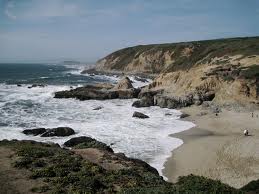
We drive out to the head of Bodega Bay, and get out and walk.  There are small rivulets coming down out of grassy, mossy, reedy "valleys", whose streams disappear into the sand.

Children are playing, and the surf is crashing, and you understand why the Egyptians called the Mediterranean "The Great Green."  Arthur notices the distinct celadon color as the waves crash on the beach.

A crowd of people are standing at the crest of a hill overlooking the ocean.  There are whales!  Their plumes explode from the waves and we see their shiny bodies as the pod frolics in the water.

A lone, wind-swept cypress stands sentinel on a near-by hill.

As we drive back, I notice that the valleys we wind around as we make our way back up the coast are filled with cypress, their deep blue-green contrasting with the other trees and grasses.

In Petaluma we look for an ice cream place, soon discovering Lala Creamery - http://www.lalascreamery.com/, where I have a cup of vanilla bean, and Arthur has a Meyer Lemon sherbet.

We walk by an antique shop and Arthur is intrigued, so we go in and meet Pierre Clauzon, who runs Pierre Art and Antiques in Petaluma.  There we found everything from a baptismal font from Glasgow, Scotland, a beautiful piece of 20th Century French silver, interesting prints, photos and paintings.  Pierre was very charming and we heard stories about the various pieces.


Back on 101, quickly moving from Saturday into The City and streets and people.

It was a wonderful day.

30 July 2010

Rant Alert: Quit Making it Look Like a Choice

The Kids are Alright
or: Something's Wrong in Hollywood


We just got back from seeing the mildly humorous The Kids are Alright at the Bridge Theater.  I loved seeing Annette Benning, Mark Ruffalo, and Juliane Moore do their stuff.  They're charming and funny and Annette Benning's laughter is simply infectious.  But there is something at the heart of this film that I find dis-heartening and angry-making.  It is not peculiar to this film.  We've seen it in the past in Paul Ruud's film, The Object of My Affection (1998), and in Christina Ricci's film The Opposite of Sex.

The Object of My Affection


The Opposite of Sex


There are others that I just can't recall at this point, but the heart of darkness in all of these films is the easiness in which the gay characters fall for the straight characters - as if it were an easy choice.  The opposite (straight men falling for gay men) is the fantasy of many a gay porno flick, but this sub plot in a film of this type is an insult.  That Jules should fall for Paul has no psychological background in the film.  At least there was nothing of the weight that should or could over-ride the basic wiring of the character.  The subtext is - "Oh, if they really wanted to, they could all change."

The buzz about the film, prior to release was of the "how neat we get to see a working lesbian-family relationship".  That, however is not its substance, and we are betrayed by a different sense and a different spirit.  It is the same old story, despite the ending.  The time-bomb is planted, and old notions about sexuality will soon explode in the audience's psyche.

What a disappointment.  End of rant.

27 June 2010

Time with old Friends


This last weekend was a delight with the visit of my old classmates The Rev. David Peters, from Sacramento, CA., and The Rev. Dr. Fred Niedner, from Valparaiso University in Indiana.  It was a weekend of old memories, discussions on the Old Testament, the Church, and coming to grips with our lives as older men.  It was also a weekend of eating.  Noted below are two recipes that seemed to work well:

Cream of Carrot Soup with Duck Confit


4 duck confit legs
4 Tbs unsalted butter
1 yellow onion chopped
6 carrots, peeled and sliced
1 stalk celery sliced
1 large potato, peeled and sliced
3 Tbs chopped parsley
5 cups veal (or chicken) broth
1 cup heavy cream
Salt
Pepper

1.  Saute celery, onion, and carrots in butter for 15 minutes.
2.  Add parley and potatoes and saute for 2 minutes
3.  Add broth, and cook in partially covered pot for about 20 minutes or until potatoes are done.
4.  In an iron skillet heat the duck confit until browned on all sides.
5.  Remove meat from the bone and loosley chop
6.  Blend the soup, and return it to the pot
7.  Add in cream and stir until warm.
8.  Salt and Pepper to taste.
9.  Arrange duck pieces in bottom of soup plate, and cover with the carrot soup.

Serves 8


Peruvian Style Corn and Zucchini
My daughter Anna joined us for dinner on Sunday evening, and I served a vegetable dish that was in the Chronicle's food pages that day.  Some changes were made, but we all enjoyed the dish.

Medium onion chopped
1 1/2 Tbs Olive Oil
3 cloves garlic chopped
1 1/2 cups fresh corn kernals
2 medium zucchini, quartered lengthwise, and then cut into 1/2 inch slices
1/8 tsp of powdered ginger
1/4 tsp paprika
1/2 tsp ground cumin
3 Tbs crème fraiche
1/2 cup grated Parmesan cheese
Tabasco
squeeze of lime juice
Salt and Pepper to taste

1.  Saute the onion until soft and translucent, about 10 minutes
2.  Add the garlic and saute until it releases its aroma
3.  Add corn, zucchini, and cook for 2 minutes at a lower temperature
4.  Add the ginger, paprika, and the cumin and cook for 2 minutes
5.  Add 1/2 cup water, stir, and cover - cooking for 5 minutes
6.  Stir in the crème fraiche and cheese and stir - season to taste
7.  Season with Tobasco to taste.
8.  Add a squeeze of lime juice

Serves 4


29 May 2010

Mahogany Risotto with Duck Confit and Fresh Peas


I wanted to make risotto, and suddenly realized that I didn’t have enough Arborio rice.  Arthur suggested that I use some of the Mahogany (Black Japonica) rice that we had around.  This is the recipe that resulted.  It employs two methods.  The first method cooks both of the rices together, and results in a nutty al dente dish.  The second method pre-cooks the mahogany rice, giving both rices the same texture in the final dish.  I hope that you will enjoy this.

For 6 persons

1 cup of shelled English peas
2 tablespoons of chopped green garlic
1 tablespoon of unsalted butter
1 cup boiling water
2 legs and thighs of duck confit, or 4 legs
½ cup white wine
5 cups of beef broth and cooking water from the peas, combined
(1 cup of beef broth – Method 2 only)
2 tablespoons of yellow onion chopped
4 tablespoons unsalted butter
3 tablespoons vegetable oil
1-½ cups of Arborio rice
½ cup of Mahogany rice
Salt and Pepper to taste
1/3 cup freshly grated Parmesan cheese.


Pre-cooking for Method 2:
  1. Heat the 1 cup of beef broth until boiling
  2. Add the ½ cup of Mahogany rice, and boil for 15 minutes.
  3. Drain the rice and set aside, add any remaining broth to the 5 cups of broth.

Preparing the Risotto
  1. Melt 1 tablespoon of the butter in a saucepan and sauté the green garlic until soft and giving off its aroma.
  2. Add the freshly shelled peas, and sauté for 2 or three minutes.
  3. Add enough boiling water to cover the peas, and boil for five minutes
  4. Drain peas and set aside, adding the cooking water to the 5 cups of broth
  5. Roast the duck confit in a 400º oven for 10 minutes.  When it has cooled, cut it from the bones and cut into smaller pieces.
  6. Melt 3 tablespoons of the butter along with the vegetable oil and sauté the onion until translucent.
  7. Add the Arborio rice (and the Mahogany rice if using Method 1) and sauté for 2 minutes.
  8. Heat the five cups of liquid (broth, and cooking liquids) so that it is simmering
  9. If using Method 2, add the partially cooked Mahogany rice and stir into the Arborio rice.
  10. Add the broth by ladleful (ca. ½ cup) stirring until it is absorbed and then adding another ladleful.  Stir the rice to prevent any sticking.  This process takes about 20 – 30 minutes.
  11. When you are down to one ladleful of broth, add the peas, and duck confit pieces and combine into the rice.
  12. After the final ladleful, add in the additional butter, cheese, and wine.  Stir until absorbed. 
  13. Salt and pepper to taste.

I hope that you will enjoy this hearty risotto.