03 May 2014

1 May 2014

Kunst als Dinge


The day begins with the delights of the Zwinger, namely the beautiful Nymphaeum with its many fountains.  It’s also raining today, so the theme of water is appropriate – Arthur runs back to the hotel (a short distance) to get umbrellas. 


We enjoy the fountains, both earthly and heavenly; have some tea and then move on to the Museum at the Rezidenceschloß. 


There is a lot there to do. The collections include the Grünes Gewölbe, (the “Green Vault), the Neues Grünes Gewölbe, the Kypfertisch-Kabinet (historical prints and drawings), the Rüstkammer (Armor), the Türkische Cammer, and the Münzkabinett (Coins and Medals).  We decide to jettison the coins, and the prints and we go at the remainder gradually, starting with the Neues Grünes Gewölbe.  At the risk of being a philistine, it’s a collection of very expensive stuff: plates, statuary, gold, silver, jewels, you name it.  It is the “things of life” (and here I make a pun in that there is a subsequent exhibition at the Schlöß called “The Things of Life / The Life of Things – on which I will comment later. 


These, however, are not the ordinary things of life.  These are the things of the elites, and all assembled in one room it becomes something like eating several hot fudge sundaes.  It is enjoyable, and at the end of our run through I wonder what the real green vault, the one with even more precious things, will give to us.  We have a set time for this exhibition, so we rush through the armory room and the Turkish room, and stop for a light lunch where I have the most delicious Rotegrütze mit Vanillesoße, I think that I’ve ever had.  It’s compote of red fruits and is wonderful.  The recipe is here.


Now we see the real thing, the real Green Vault.  We submit our tickets and wait to enter through a sally port.  These rooms are interesting in that some of them survived the 1945 firestorm.  Those with windows facing the street were largely spared.  Those whose windows faced the courtyard were destroyed.  All have been completely restored, and the setting is quite beautiful.


These are not the things of life, however, these are beyond all of that – quite precious, and perhaps quite unnecessary.  Gifts between kings and princes are the stuff of fantasy and pretense.  They are fun to look at, but soon my eyes glaze over.


As it to ameliorate the effect of all this opulence, the display of “The Things of Life / The Life of Things” does not make a significant point.  A series of photographs by Wolfgange Scheppe is poised against a series of 99 bowls already held in the collection, which range from the sublime to the ridiculous. 


Neither of us “got it” and the commentary that accompanied the exhibition seemed specious at best.  So, our heads filled with so many images and sensations, we decided it was time to rest – to eat – and to absorb.  Meanwhile, back at that Rotegrütze…


02 May 2014

30 April 2014


Kunst als Wißenschaft, Kunst als Argument


The Zwinger is so close to us that it is always a temptation to use it as a “bridge” to the Altstadt.  This morning, I discover that there are fountains along the far pavilions as you enter from the Gemäldegalerie.  They are quite lovely adding another dimension to attract both eye and ear.  We visit the Mathematisch-Physikalischer Salon, which is a collection of scientific instruments from the 16th century onward.  The 16th century pieces, largely automatons, measuring systems, and clocks, are beautiful beyond belief – propaganda, really, underscoring Saxonia’s technical prowess. 


Also included are a large collection of optical and other instruments including solar ovens, vacuum machines, telescopes, early barometers, and some of the very first calculators.  As we learned later, Dresden was always seen as a center for technology, an expertise that continued on and was \ exploited during the DDR, but to little economic effect. 


After our visit to the Zwinger, we moved over to the Albertinum, and their collection.  There was much to see there, and the most outstanding thing in terms of Kunst als Kunst was the Klingersaal, with wonderful sculpture and paintings by Max Klinger, Arnold Böcklin (my all time favorite) and others.  These galleries formed a foundation, if you will for what we would see in other galleries.


There was a special exhibition at the Albertinum, Nach Ägypten! Die Reisen von Max Slevogt und Paul Klee, which documents the separate travels of Max Slevogt and then later Paul Klee to Egypt.  What happens is a direct influence of the light, color, and monuments of Egypt by both of the painters.  Of particular interest was Paul Klee’s adaptation of the Egyptian sense of proportion (1 – ½ - ¼ - 1/8), which can be seen in many of his works.


The real star of the day, however, was an exhibition revolving around Otto Dix’s monumental painting Das DrednerTryptichon, an argument against war that draws on the artist’s experiences during the First World War.  The exhibition draws you though earlier drawings and studies for the final painting, and then orients you philosophically through references to three other works of art.

Matthais Grünewald - Crucifixion
Albrecht Dürer - Melancholia
 
Francisco Goya - Los Desastres de la Guerra

In an odd way it reminded me of an exhibition at The Academy in Florence in 2009 where sculptures by Michelangelo were juxtaposed to photographs by Robert Mapplethorpe.  (If you wish to read about this, please click here.)  That juxtaposition was all about form, while the Albertinum experience was about content, emotion, and interpretation.  To see the Tryptichon not only through the eyes of Dix, but of Grünewald, Dürer, and Goya as well, was quite a commentary on war – a poignant point in Dresden.  


All of this precedes the actual viewing the painting by Dix, you come upon it prepared, but not prepared, and following the time with the painting, a room behind, plays footage from the First World War.  It is sobering.


As we leave the Albertinum, we walk around the Rathaus, which is being extensively reworked.  There in front was a statue clearly from the DDR period.  There have been several pieces that we have noted, especially the front mural on the Palace of Culture.  One hopes that not everything is trashed, or moved out of context (as is the case in Budapest).  History is history und Kunst ist Geschichte.

01 May 2014

29 April 2014

Flowers, flowers, flowers


Having seen them docked on the Elbe, we decide to take a river cruise up to Pillnitz, the site of a Schloß overlooking the river.  The boat is a paddle wheeler, and it is delightful, with a nice wood interior, and a helpful staff ready to serve.  The trip up the river is one hour long, and will give us four hours in Pillnitz, and then a return trip.  The boat reminds us of the paddle wheeler that we took from Brien zee to Regensberger Falls in Switzerland.  The engine is open for all to view and is beautiful as a piece of workmanship.


Here is this beautiful piece of machinery in action:


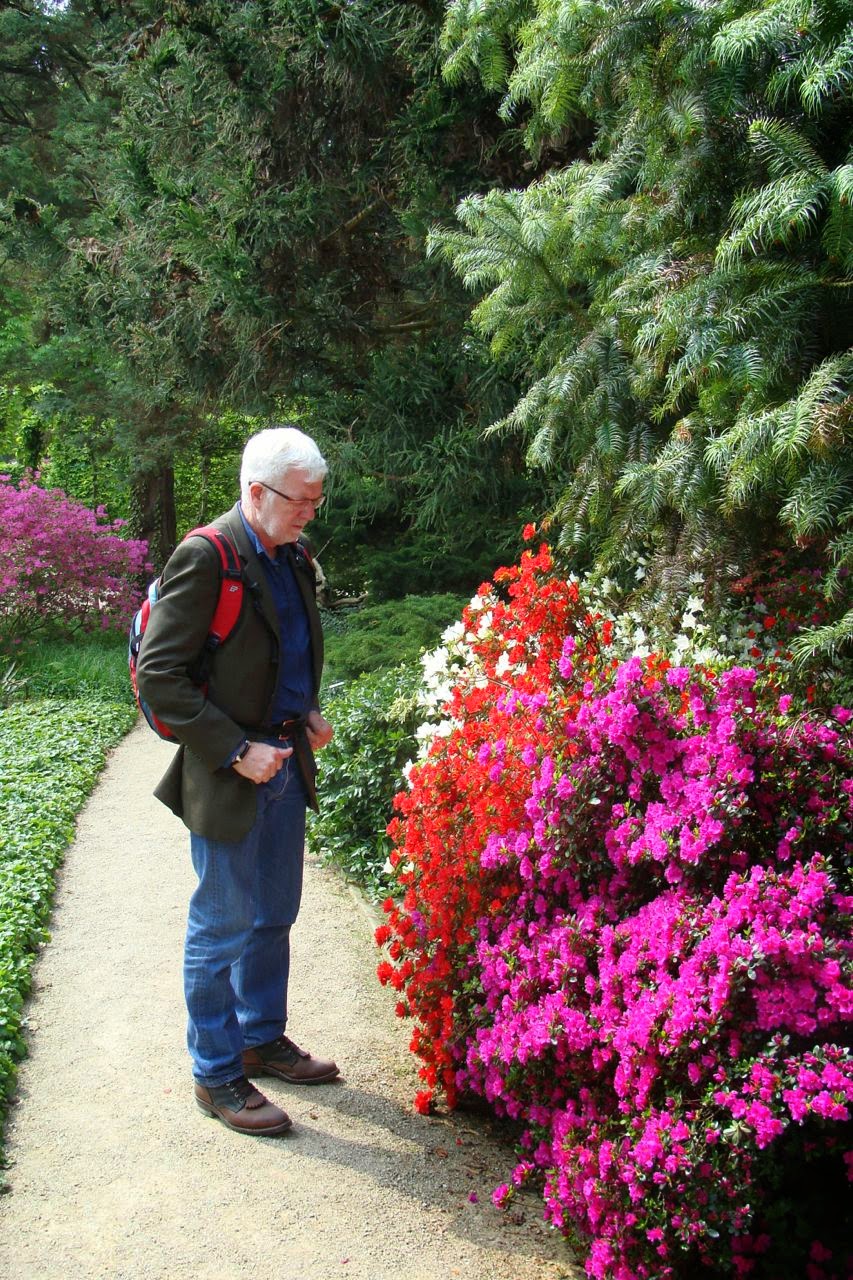
There is not much to say about the whole experience other than that we got to spend a great deal of time walking about the Schloßpark, looking a flowers, having lunch, and just relaxing.  What follows, then, are some pictures of the gardens.


On the way back we see (from the river) the beautiful Lutheran church, Maria am Wasser.  The Pfarrarin there had drinks with us after our Anglican service at the Frauenkirche on Sunday evening.  I wish that we had had the time to meet her at her church.


As we continued up to Dresden we say many of the villas and country homes that line the river, including a few vineyards.  It was all very relaxing.


That evening we went to an organ recital at Kreuzkirche.  The organist from the Roman Catholic Dom played selections from local composers whom I did not recognize, but also some transcriptions (Karg-Elert) of Wagner (Elizabeth Gebet, and something else from Tannhauser).  The program closed with a three part improvisation on O filii et filiae – quite joyful.